|
By
Wendy Harris
 It’s
8:15 a.m. Electric guitar chords blast through the airy auditorium as
Charles Kruger rehearses some Nashville-style hymns. A couple of students
are singing the words, reminding him what the music sounds like so he
won’t be totally lost at chapel later this morning. Within a minute or
two, he declares it a wrap, packs up his guitar and heads off to his
portable classroom where he teaches Grade 11 and It’s
8:15 a.m. Electric guitar chords blast through the airy auditorium as
Charles Kruger rehearses some Nashville-style hymns. A couple of students
are singing the words, reminding him what the music sounds like so he
won’t be totally lost at chapel later this morning. Within a minute or
two, he declares it a wrap, packs up his guitar and heads off to his
portable classroom where he teaches Grade 11 and
OAC English.
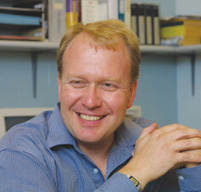
Chuck, as he’s known to everybody including his students, has just arrived
at Rockway Mennonite Collegiate in Kitchener from his modest home in St.
Jacobs. He kissed his wife Linda and his youngest son Matthew good-bye and
drove the 20 minutes to school with his two older sons, Nathan and Daniel,
both of whom are students at Rockway.
Just before 8:20, when classes begin, Kruger parks his guitar in a corner of
his "private domain" portable and greets the students who are
trickling in from the main building. His Grade 11 class looks like a group
of typical 16 and 17-year-old kids — lots of gelled hair, piercings in
unlikely spots, a jean jacket with "Rock for Life" plastered on
the back of it. Their parents have sent them to this independent, semestered
school for a faith-based education that not only actively promotes some of
the central tenets of the religion like pacifism but is also intellectually
progressive and focused on the arts, particularly music.
About 60 per cent of the 477 students at Rockway are Mennonites. Another 15
per cent are international students — many from mainland China — who
have no faith or are Christian. The rest come from a variety of backgrounds:
a few Muslims, a Jewish girl and other denominations of Christians.
Kruger himself went to Rockway when his father was principal in the 1970s
and there were 76 students. Now the one-storey concrete school has grown
considerably, with many additional classrooms, a new gym and a round meeting
room (decorated with a collection of dazzling quilts and boasting a 15-foot
round oak table), all built in the early 1990s. Now, the school is again
"bursting at the seams," says Kruger, and so he teaches all his
classes in Portable 6.
This morning, the Grade 11s are studying Macbeth. They start with an
informal quiz in which Kruger reads a line from the first couple of scenes
and the students have to paraphrase it and figure out which character is
speaking and to whom and the context for the line. "Chuck, do we get
prizes?" asks one student, who knows her teacher is always up for some
banter.
The quiz leads easily into a discussion of some of the major themes of
Macbeth and the kids are totally absorbed by the text now. They talk about
the reversal of the natural order, the nature of fate and the nature of
evil. "We like to explore the darker side," Kruger tells his
class. "How can you possibly understand people if you don’t
understand all their sides?"
When class ends, the entire school meets for chapel, which takes place twice
a week. Today Kruger gets to do his "rock-star thing" with the
electric guitar. The students sing and hear a report from some who went to a
summer youth meeting.
Kruger says the most important thing he can do as a teacher is to really
engage his students so that they bring their hearts, minds and spirits to
the task of learning. Teaching for him is always an exploration of
techniques that will allow him to make that kind of contact. Humour is one
of his most powerful tools.
During his next class he gives his OAC students three choices for how to go
about studying King Lear: traditional teacher-led, student-read, or
student-acted. Kruger says, "The first is kind of ‘Chuck-based’. I
personally cannot imagine anything better. Next is ‘student-read,
Chuck-interrupted.’ The third is to act it out, again
‘Chuck-interrupted.’ I get to be intrusive wherever we go."
After some laughter and noisy debate, the students opt to try all three
methods and choose what they like best tomorrow.
As he leads his class, Kruger is constantly encouraging, calling one
student’s observations "brilliant" and another comment
"awesome." In response to a question about Shakespeare’s use of
Greek gods in his plays, Kruger says he doesn’t know much about the
subject, but he’ll research it and report back to the class if they’re
interested. He nudges his kids towards discussing the ideas of the play,
even if they can’t fully appreciate the writing. He drags in themes,
characters, language and prods everyone towards a deeper appreciation of
Shakespeare. There are rarely "right" answers in Kruger’s class,
just more enquiry and more discovery.
"I go with how I’m feeling and how they’re feeling. To go with the
flow means I have to always be alert as opposed to following a script I made
up yesterday or last year. It’s people first and curriculum second,"
he says later.
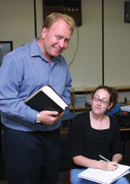
Over a lightning-fast lunch of leftover pasta, Kruger says that even though
teaching runs in his family (his mother also taught at Rockway), he went to
the Canadian Mennonite Bible College to study music and theology. Although
he had no intention of becoming a minister, he did want to "play music
and think. I was a real classical music snob."
But after spending a few years practising the clarinet in isolation for six
hours a day, he realized he needed to be with people. He never abandoned
music, though. He taught it and now he plays electric guitar with a
60s-style country rock band. Kruger got his Master’s in English at the
University of Waterloo and then earned a teacher’s certificate. After four
years as a music teacher in Saskatchewan, he came back to Ontario where
he’s been teaching for the last 15, first at Woodland Christian School and
for the past decade, at Rockway. "I always wanted to teach here,"
he says. "It just seemed like coming home."
After 19 years of standing or conducting in front of a class, Kruger says
what’s central to his teaching is self-knowledge, a "real
understanding of who I am. I am discovering more and more that if I’m
reading a lot and thinking a lot, I’m going to be a much better
teacher."
When he first started, his lessons were largely teacher-centred. Over the
years, that style has loosened to allow for more interaction with his
students, the kind of interaction that leads to the intellectual engagement
he seeks. But he does retain some old-fashioned teaching notions. Memory
work, for example, is extremely important. He says, "They will memorize
the ‘Tomorrow and tomorrow and tomorrow’ speech." Also important is
a solid framework of learning so that students always have a structure they
can rely on. Each day what was covered in the classroom, as well as their
work, is posted on a homework web site so that even if students are
uncertain about what all the freewheeling discussion meant in class, they
can figure it out after, online.
During the last period, Kruger teaches Macbeth to another Grade 11 class.
These students are really keen to do some acting. But before they do, Kruger
delivers a couple of the quick "impassioned speeches" that he
sprinkles throughout all his lessons. One speech is about how a "rough
draft is a rough draft because it’s a rough draft," meaning that
it’s paramount that students initially allow free rein to their ideas. The
refinement will come later.
Another is about his pet peeves in essay writing, like never saying "in
this essay," or "in conclusion" or "firstly" and
"secondly" and "thirdly." "Can you tell I have some
serious issues here?" he jokes. He also does a "little writing
speech" where he tells his students how moved he was by the essays they
wrote in response to the terrorist attacks in New York and Washington on
September 11. "You guys are really amazing writers," he tells the
class.
Kruger is clearly adored by his students, not only because they have a lot
of fun in his class but because they are always challenged there. "He
really talks to you, person to person," says one German exchange
student.
Other comments revolve around how funny, how interesting, how enjoyable his
class is, so much so that the students barely recognize just how much they
are learning.
It’s 4:30 p.m. when Kruger pulls out of the parking lot after rounding up
his sons. Waiting at home is Linda, a part-time social worker, a cup of
coffee, and a chance to sit and relax. Two hours of marking wait until after
dinner.
Now he reflects on his day and teaching in general. What makes a good
teacher? Kruger answers that question with two of his own. "Do you love
kids? Do you love learning?"
Charles Kruger
Rockway Mennonite Collegiate
English
Certified in 1982
Faculty of Education,
University of Western Ontario
first
page
previous
page
next
page
|